
A single job advert can bring in hundreds of applications. Reading them properly takes days that recruiters do not have, so in practice many are skimmed and some are never opened. AI can do the first read of every one. The question is how to use it without handing over a decision that belongs to people.
What does AI do in recruitment?
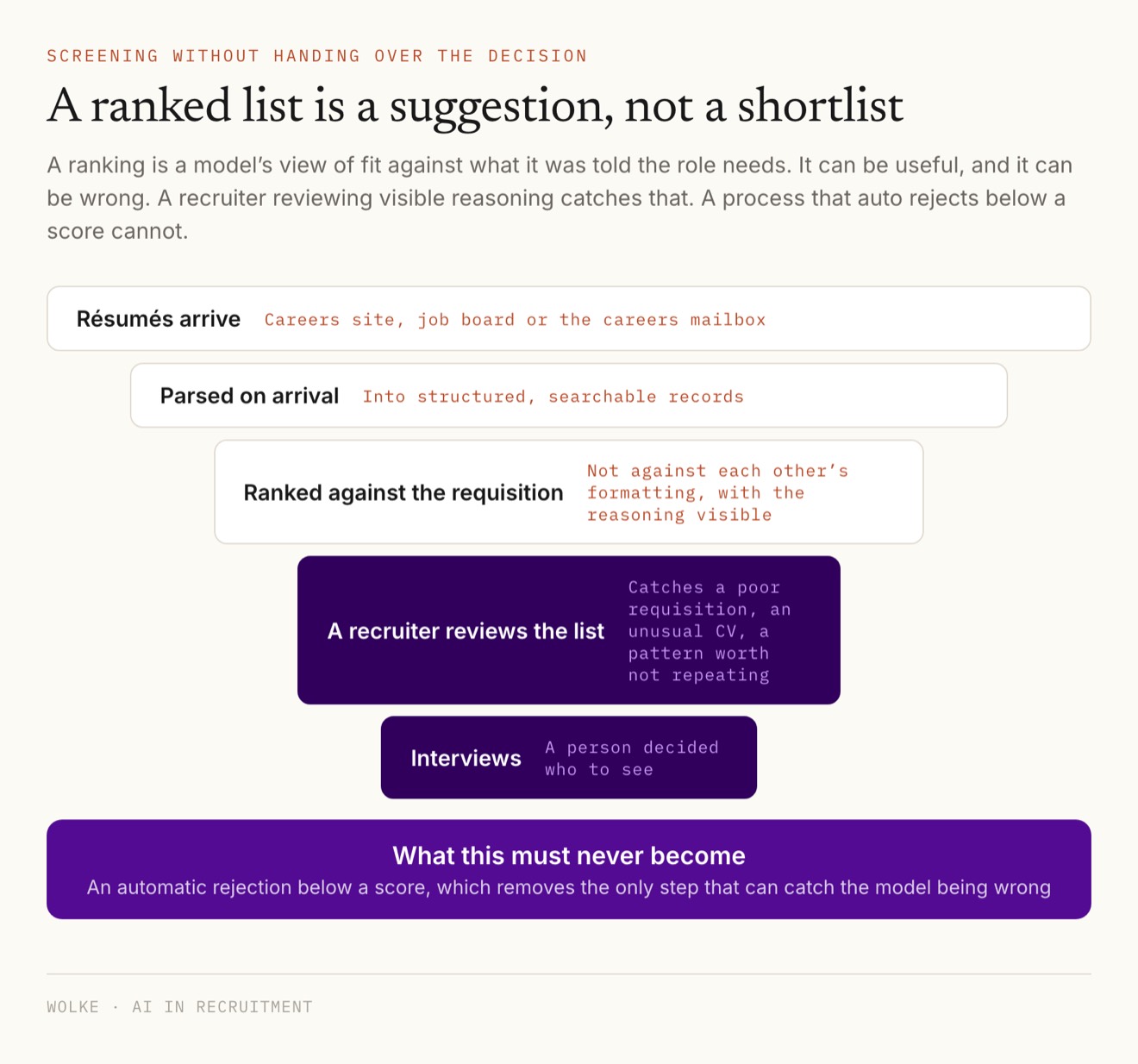
- Parses résumés into structured, searchable records the moment they arrive, whether through the careers site, a job board or the careers mailbox.
- Ranks candidates against the requisition, not against each other’s formatting, with a score and the reasoning behind it.
- Reviews one candidate in depth: strengths, gaps, red flags and questions worth asking at interview.
- Searches the talent pool in plain English, so last year’s runner up is findable when a similar role opens.
- Drafts job descriptions from the approved requisition.
Why the ranking must stay a suggestion
A ranking is a model’s view of fit against what it was told the role needs. It can be useful, and it can be wrong: the requisition may be poorly specified, a strong candidate may describe their experience unusually, or the model may reflect patterns in past hiring that you do not want to repeat. A recruiter who reviews a ranked list with visible reasoning can catch all of that. A process that auto rejects below a score cannot.
How to use AI in hiring fairly
- Rank against the requisition, with criteria you would be comfortable defending.
- Show the reasoning behind every score to the person reviewing it.
- Never auto reject on the score alone. A person decides who to see.
- Use structured interviews and scorecards after the screen, so the human part of the process is consistent too.
- Check outcomes over time for patterns across groups of candidates.
- Tell candidates that AI is used in screening.
What recruiters gain
Time back for the part of the job that needs a person: talking to candidates, understanding hiring managers, and closing offers. Every application gets a proper first read, which is fairer to the candidates who would otherwise never have been opened.
What AI should never assess
Screening should be based on the requirements of the role and nothing else. Characteristics such as age, gender, nationality, religion, marital status or appearance are not evidence of ability and should play no part in ranking. That means leaving photographs and personal details out of the criteria, and checking that the model is not picking them up indirectly, for example through dates or names.
Candidate experience
Candidates notice when an application disappears. The time AI saves at the screening stage is best spent on the candidates: faster responses, clearer next steps, and a decision, either way, sooner than they expected it.
How to pilot it without risk
Do not switch screening over. Run it in parallel on roles you are already hiring for, and compare.
- Pick two or three role families, ideally ones with high application volume where the current process is genuinely failing to read everything.
- Screen as you do now, and separately record what the AI would have ranked, without letting it influence the decision.
- Compare the two lists. Who did the AI surface that your process missed? Who did it rank low that you went on to hire?
- Read the reasoning on the disagreements. That is where you learn whether the requisition was poorly specified or the model is reading something it should not.
- Only then decide whether it screens first, and on which roles.
Two or three hiring cycles is usually enough to know. A pilot that cannot be compared against anything proves nothing.
What to tell candidates
Say it plainly in the application flow: that applications are reviewed with the assistance of automated tools, that a person decides who is interviewed, and how to ask a question about it. Short and specific beats a paragraph of policy language.
Candidates are far more accepting of AI screening than recruitment teams expect, provided two things are true: a person makes the decision, and they hear back either way. The resentment attaches to silence, not to the technology.
Reviewing outcomes over time
Consistency is not fairness, and a screen can be consistently wrong. Review the outcomes periodically rather than assuming the criteria hold:
- Compare progression rates at the screening stage across groups of candidates, and look into any pattern you cannot explain by the requirements of the role.
- Check the ranking against who actually got hired and who performed. If the two diverge consistently, the criteria are wrong.
- Re read the requisition. Most ranking problems are specification problems: a requirement that was never really needed, quietly filtering people out.
- Keep the reasoning for decisions, so a challenge months later can be answered with evidence.
Where AI screening goes wrong
Three failures account for most of it. Auto rejection below a threshold, which removes the human judgement that was the safeguard. Criteria nobody reviewed, inherited from an old job description and never questioned. And proxies, where a criterion that looks neutral carries something else: a gap in employment, a university, a postcode, a date that reveals an age. Ranking against the real requirements of the role, with the reasoning visible to the person reviewing it, is what keeps all three in check.
How Wolke uses AI in recruitment
The line this article draws is between a ranked list and a decision. Here is where Wolke sits on it, mechanism by mechanism, because “the AI shows its reasoning” means very little until you say how.
- The first read, done once. Résumés are parsed on arrival into structured, searchable records, whether they arrive through the careers site, a job board or the careers mailbox. PDFs, Word files and photographed CVs all read into the same shape.
- You describe the role in a sentence. Senior HSE engineers with NEBOSH, eight years in oil and gas, available within a month. That becomes a set of must have and nice to have criteria you can see and edit before anything is searched, rather than a black box that has already decided.
- Match and possible, not a score out of ten. A candidate is a match when every must have is proven from the CV, and possible when nothing contradicts but some must haves are unproven. That distinction is more useful than a number, because it tells a recruiter what to go and check.
- Every claim quotes the line it came from. The AI drafts the criteria and quotes the CV; the search itself does the deciding. A quote only counts if the text really is in the document, so any result can be verified rather than trusted.
- Missing data is unknown, never a pass. A CV that does not mention a certificate does not quietly become a candidate who holds one.
- Protected attributes are never suggested. The AI will not put them forward as criteria. Nationality appears only if a recruiter types it, which keeps that choice, and the accountability for it, with a person.
- Drafting, with a person pressing send. Job descriptions from the approved requisition, competency based scorecard templates, and candidate emails for each stage. Every one is a starting point a recruiter edits, and nothing reaches a candidate without someone sending it.
- Scoped to the people who should see it. A recruiter mapped to one legal entity never sees another one’s pipeline, and that holds in the AI results exactly as it does in the screens.
More on how the ranking, the scorecards and the reporting work together on the Recruitment page.