
End of service gratuity is the benefit a private sector employer in the UAE owes most employees when they leave. It is calculated to a formula, so it should never be a surprise. It often is, because the number is worked out once, at exit, instead of every month while the obligation is building.
This article covers employers under the federal labour law, Federal Decree-Law No. 33 of 2021. Employers in the DIFC and ADGM have their own employment laws, and UAE nationals are generally covered by the pension system instead.
Who is entitled to gratuity?
An employee who has completed at least one year of continuous service is entitled to gratuity when the employment ends. Days of unpaid absence are not counted as service, and part of a year counts in proportion to the time worked.
Under the 2021 law, an employee who resigns is owed the same gratuity as one whose contract the employer ends. The reductions for resignation that applied under the old law no longer exist, which is still one of the most common errors in final settlements.
How is end of service gratuity calculated?
Article 51 of the law sets the formula:
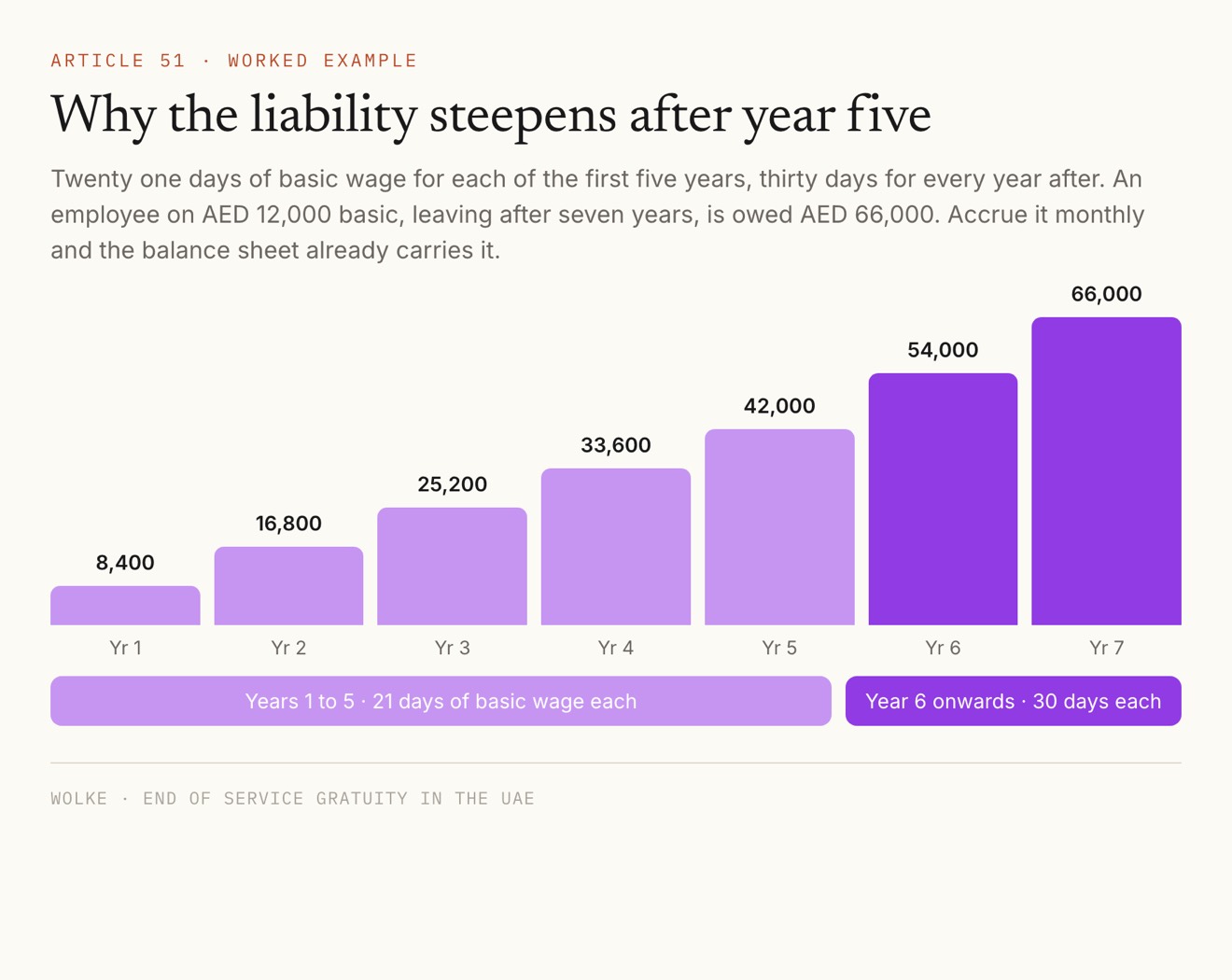
- 21 days of basic wage for each of the first five years of service.
- 30 days of basic wage for each year of service after the first five.
- A cap: the total may not exceed two years’ wage.
The calculation uses the employee’s last basic wage, not their total package, so allowances such as housing and transport are excluded. The daily basic wage is usually taken as the monthly basic wage divided by 30. Gratuity is payable within 14 days of the end of the contract.
A worked example
An employee leaves after seven years with a last basic wage of AED 12,000 a month.
| Step | Calculation | Amount |
|---|---|---|
| Daily basic wage | 12,000 ÷ 30 | AED 400 |
| First five years | 5 × 21 days × 400 | AED 42,000 |
| Years six and seven | 2 × 30 days × 400 | AED 24,000 |
| Gratuity | AED 66,000 |
The two year cap does not bite here; it would limit gratuity only for very long service.
Why the last basic wage changes everything
Because gratuity is calculated on the last basic wage, every pay rise increases the value of all the service already worked, not just the service that follows it. An employee with six years of service who receives a 10 percent rise has just increased six years of liability by 10 percent, in one month.
That is why a gratuity figure worked out once a year, or only when someone resigns, is always wrong for most of the year. It is also why an unexpected resignation from a long serving, well paid employee can land as a cash surprise.
Why accrue gratuity monthly?
- The balance sheet stays right. The provision reflects today’s wages and today’s service, every month.
- Nobody is surprised by a leaver. Finance can see the liability for any employee, or any entity, at any time.
- The annual audit is simpler. Auditors and banks increasingly ask how the end of service provision is built. A monthly accrual from the payroll record is an answer; a year end estimate is a conversation.
- The actuary gets clean data. Companies reporting under IFRS measure the obligation under IAS 19, which starts from the salary and service data held in payroll.
The savings scheme: an alternative employers can choose
Since Cabinet Resolution No. 96 of 2023, private sector employers can choose to replace gratuity with monthly contributions to an approved investment fund, instead of a lump sum at exit. The scheme is voluntary for employers, and they decide which employees to enrol.
- 5.83 percent of the basic wage a month for an employee with under five years of service.
- 8.33 percent a month once the employee has five years or more.
- Gratuity already earned is kept. It is fixed at the date of enrolment, on the basic wage at that date, and paid when the employment ends. No backdated contributions are needed.
The rates are the gratuity formula paid monthly: 21 days and 30 days of a 360 day year. For an employer, the choice is between holding a liability on the balance sheet and paying cash into a fund every month. Either way, the figure starts from the same basic wage and service record.
Common mistakes
- Calculating on the total package instead of the basic wage, or the reverse where a contract says otherwise.
- Counting unpaid leave as service.
- Reducing gratuity for an employee who resigned, as the old law allowed.
- Forgetting that a pay rise revalues past service.
- Holding the calculation in a spreadsheet that is updated once a year.
How Wolke handles gratuity
The mistakes above share one cause: the number is built at the exit instead of carried on the record.
- Accrued from day one, not reconstructed at exit. Gratuity accrues monthly against the employee record, so the liability on the balance sheet is the figure the employee actually leaves with.
- On the rules of the market the employee is employed in. The accrual follows the record, so when pay changes the liability moves with it rather than at year end.
- Testable against your own assumptions. You can run a sensitivity analysis against your IAS 19 assumptions instead of finding the gap when the actuary does.
- Gratuity or the savings scheme. Wolke calculates the traditional gratuity and the savings scheme payout, and pays either in the final settlement run.
- Every run checked against the last one. Variance against the previous cycle is shown line by line, so a basic wage that jumped or an allowance that vanished, exactly the movement that quietly changes a gratuity figure, is seen before anyone approves the run.
More on how end of service is accrued and reported on the Payroll and WPS page.