Wolke AI | Live demo | See the AI-native HR platform. Book a demo 

+971 4 513 9090 Search United Arab Emirates (EN)

Learning

Know who is compliant without maintaining a spreadsheet

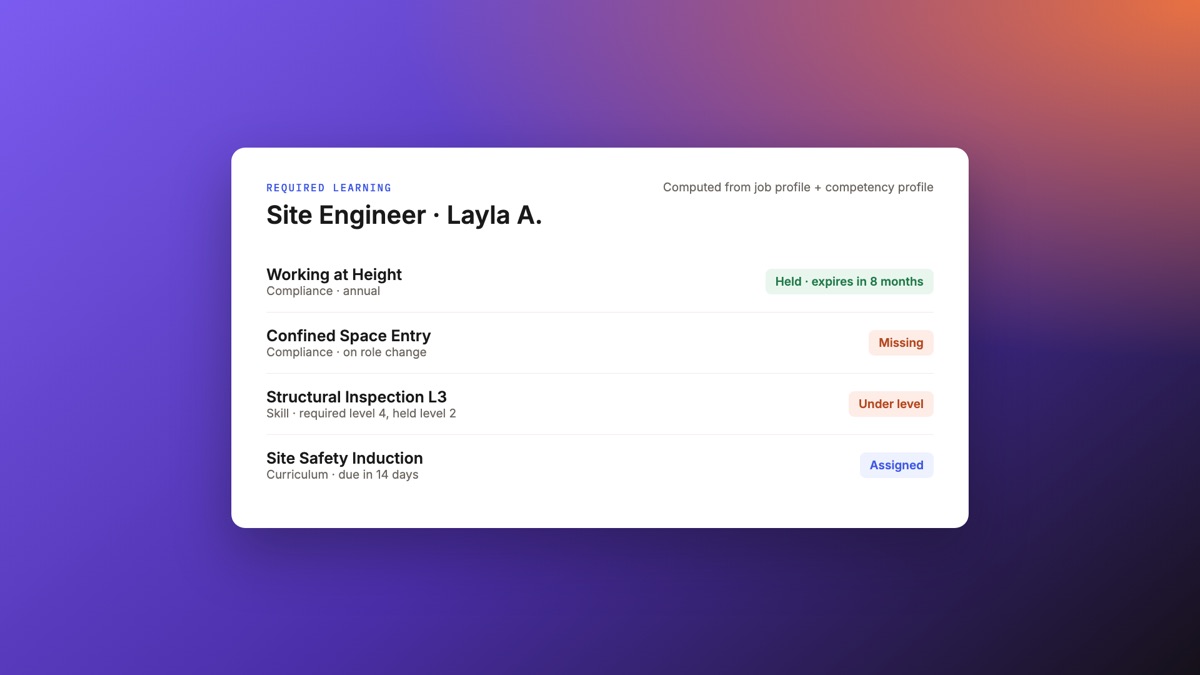
Required learning is computed from each job profile and competency profile, then compared against the skills, courses and certifications the employee actually holds.
Trusted by

Requirements you do not maintain by hand

A standalone system has no idea who your people are. It has to be fed an employee list, told which job each person does, and kept in step every time somebody joins, moves or is promoted. This one already knows, because it reads the same record as the org chart.

  • Required learning derived from the job profile and the competency profile together.
  • Compared against the employee's real skill ledger, completed courses and certifications.
  • A live gap report per person, generated rather than maintained.
Chasing that happens without anyone chasing

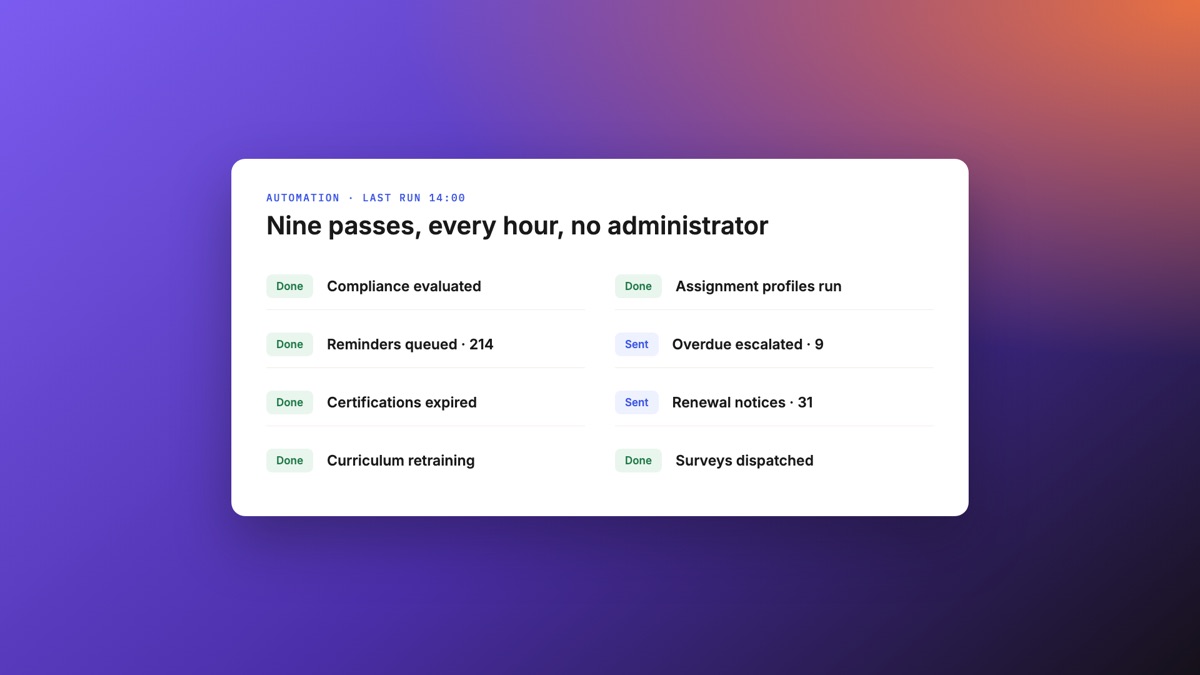
Nine passes run every hour and assign, remind, escalate, expire and re-trigger training on their own. Overdue work emails the learner first and then escalates, so following up is a system behaviour rather than somebody's calendar reminder.

  • Assignment profiles push the right learning to the right audience automatically.
  • Recurring compliance comes due again on schedule without being re-created.
  • Every pass is safe to re-run, so nothing is ever double assigned or double sent.
One completion, six consequences

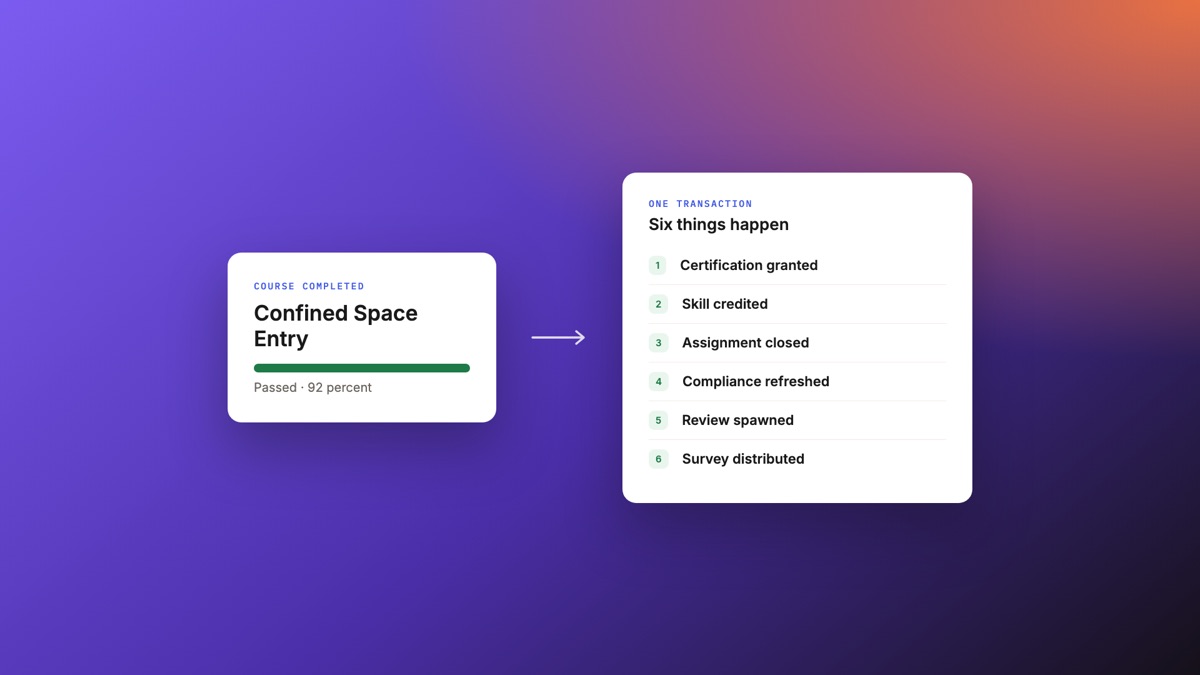
Every route to completed runs through the same code, so finishing a course means the same thing however it was reached. What follows happens in a single transaction rather than as six jobs somebody has to remember.

  • Certification granted, skill credited and assignment closed.
  • Compliance status refreshed, review spawned and survey distributed.
  • The learning path, curriculum and programme it belongs to all advance with it.

Everything inside Learning

Grouped by what they do, all reading from the one employee record.

Building the catalogue

  • Seven Course Types

    Self paced, instructor led, virtual, blended, on the job, assessment only and external.

  • Lessons and Content

    Documents, video, presentations, audio and interactive, each with its own duration.

  • Completion Rules

    Passing score, retakes, time limits and whether sign off is required before it counts.

  • Prerequisites

    Chain courses with all required or any one rules, so advanced material stays locked.

  • Versioning

    Draft through published to retired, with effective dates and a link to the previous version.

  • AI Course Drafting

    Describe the course you need and get objectives, description and outline back.

Defining what qualified means

  • Skill Library

    A managed catalogue with each employee's held skills and proficiency levels.

  • Competency Profiles

    Reusable bundles of required skills that attach to roles, defined once.

  • Job Profile Requirements

    Required skills, courses and certifications on the profile itself.

  • Compliance Rules

    Tied to a regulation, scoped by company, department, role or location.

  • Recurring Compliance

    Annual or interval based, so a completed course becomes due again on schedule.

  • Curricula

    Compliance bundles that auto assign on hire or on role change.

Delivering and proving it

  • Assignment Profiles

    Rules that push learning to everyone matching the criteria, evaluated automatically.

  • Learning Paths and Programmes

    Nested paths, and cohort journeys where everyone moves together.

  • Sessions and Waitlists

    Classroom or virtual, with capacity, waitlists and attendance recorded.

  • Assessments

    Ten question types, with a grading queue for essays and manually marked answers.

  • Certification Tracking

    Issued, numbered, expired and renewed, with notices before they lapse.

  • Compliance Status and Surveys

    A calculated compliance percentage, and Kirkpatrick surveys at four levels.

How it goes live

  1. Listen first

    We learn your business, your industry and your goals before anything gets configured.

  2. Deployment

    A proven methodology that gets you live on time and on budget.

  3. Training

    Virtual courses through to in person workshops, in whatever format your team learns best.

  4. Support

    As involved or as hands off as you want. Some of our customers are entirely self sufficient.

Learning questions, answered

It unions the skills the person's job profile demands with their competency profile, then compares that against their actual skill ledger, completed courses and held certifications. The difference is the gap report, and it is generated on demand rather than maintained by anyone.

No, and that is the point. Compliance status is a record per employee per rule, generated and maintained by the system, with an organisation wide percentage that is calculated rather than compiled. Nobody updates it because there is nothing to update.

Six things, in one transaction: the certification is granted, the skill is credited, the assignment is closed, compliance status is refreshed, any review is spawned and the survey is distributed. The path, curriculum or programme containing the course advances at the same time.

Yes. The model deliberately follows SuccessFactors, so assignment profiles, curricula, programmes, learning paths and item requests all mean what an SF trained team expects them to mean. They are productive on day one without the licence cost or the implementation project.

Book a demo

See it running against your own business

Tell us who you are and where you operate. One of our experts will come back to you to arrange a time.

What the demo covers

  • Your markets, your entities and your pay calendar, rather than a generic walkthrough.
  • The parts of the platform you actually asked about.
  • Time for your questions, with someone who knows HR and payroll in your markets.

Your details

Please enter your name.

Please enter a valid email address.

Please enter your company name.

Please choose a country.

We use these details only to arrange your demo. How we handle your data.

Thank you.

One of our experts will be in touch to arrange a time. The demo will run against the markets you told us about.

Cookie preferences

Choose which cookies we can use. Necessary cookies are always on, because the site needs them to work.

NecessaryAlways on

Remember your cookie choices and keep the site secure. They store nothing that identifies you.

Google Analytics. Tells us which pages are read and how people arrive, so we can improve the site.